Medical World
30 posts
- Dear Ostad Assar, it is a little difficoult to explain so I will do my best to be as much clear as possible.
I usually feel the pain "under" the sartorius on the left side, very close to the femur. As I said, today coming back from work I felt something move and at the end going back in place I stopped feeling the "electrick shock".
Another point (but this is only when I do stretching exercize) is the back left knee at the level described in the picture I added B53, the end of biceps femoris. When I feel the tension there I avoid to continue the exercize.
For warm up exercize I ususally spent 15 or 20 minutes and then I go on technique's study, at the beginning soft and low with the legs and only at the end I put some energy because I am more concentrate on the correct move and balance (like keeping the head in axis).
I did'n thought about the fuel intake. Maybe I should drink more, when I work ususally I don't have time and sometimes I totally forget it!Could this be the reason? - Your problem is typic problems of biceps femoris muscle tendinopathy .I will explan it in the study of muscles and muscles injuries.
thank you so much - Thank you so much dear Jamshid! It is good to know what is it finally! I'm looking forward.
- SIX MISTAKES
Here are the 6 WORST things you can do if you want to ignite your body's own fat-burning furnace and get lean, strong & totally ripped in less time:
Mistake #1: Doing isolated exercises
Doing isolated exercises like bicep curls and tricep kick-backs will not get you any significant results. These one-muscle-at-a-time moves simply don't stimulate enough muscle fibers to build lean muscle or expend enough energy to maximize your calorie burn.
If you want to build lean muscle while burning fat so you can get serious definition, you need to perform exercises that stimulate as many muscles and expend as much energy as possible at the same time. Using these types of exercises (we will learn later) will dramatically accelerate your results.
Mistake #2: Working out with machines
Fancy machines may make the gym look high-end, but truthfully, about the only thing they're good for is for sitting down while you tie your shoes or catch your breath! The problem is this: Machines alter the way your body naturally moves and restrict your range of motion. This severely limits your ability to fully activate all of your muscles fibers -- that means less fat burning and less muscle definition. Worse yet, machines can cause excessive strain on your joints, leading to nagging injuries down the road.
If you want fast results, it's critical that you incorporate exercises that allow your body to move naturally with full range of motion so you can skyrocket your metabolism and tone your entire physique. In the futur, Iwe will explain the 6 primary movements that are the foundation of these full-body exercises...and we will also fill you in on the best types of weights to use for your workouts.
Mistake #3: Doing long bouts of cardio
Look, you need to do cardio if you want to lose weight and burn fat...BUT there's a right way and a wrong way to do your cardio workouts. If you've been pounding the pavement or the treadmill with nothing to show for it (except sore joints and a pair of stinky worn out sneakers), you already know it takes a lot of effort to get minimal results.
In the futur , we will reveal the most effective way to pump up your cardio routine that will get you insane results in half the time of your regular cardio workout -- without causing unnecessary stress on your joints.
Mistake #4: Doing crunches and sit-ups to get 6-pack abs
If you want washboard abs, doing traditional ab exercises like crunches and sit-ups WILL NOT get you a six pack. In fact, doing any exercises that target your abs won't get you a six pack either! These so-called "ab" exercises are a complete waste of time. They don't make your abs get any more defined and they definitely don't burn any fat. The key to getting sculpted abs is to burn off that stubborn layer of belly fat that's hiding them! In the futur , we will show you how to burn away the "ab flab" while stimulating all 6 of your abdominal muscles at the same time so you can finally carve out your six pack abs.
Mistake #5: Repeating the same workout routines over and over
Repeating the same workouts over and over is a surefire way to STOP getting results. We're creatures of habit and we tend to stick to things we're familiar with and good at. But when it comes to your workouts, if you want to keep making progress and keep seeing changes in your body, you've got to start switching things up.
You see, your body has an amazingly ability to adapt quickly and when it does, that's when you hit the dreaded plateau and you stop making progress. Later, we are going to tell you exactly how often you need to change up your workout routine so you can keep your body guessing to accelerate the results process.
Mistake #6: Doing long workouts
Longer workouts do NOT equal better or faster results. If you've been slaving away at the gym and your body isn't visibly changing, you can't do more of the same thing and expect a different result.
When it comes to getting lean and fit, your body responds to quality over quantity. we will tell you a way to super-charge your workouts -- this simple, yet overlooked method is the single fastest way to getting lean and ripped while cutting your workout time almost in half. - Fitness Testing :
Fitness testing is a way of gaining information about the health related and skill related components of an athletes fitness. Testing can take place in a number of environments, with laboratory testing being the most accurate, however there is still a large range of tests that can be carried out, away from a lab, which provide a lot of useful information.
Reasons for Fitness Testing :
To highlight the strengths and weakness of an athlete enabling a training program to be devised which addresses the findings
To evaluate a training program, to see if it is helping the athlete in achieiving set goals
To measure fitness levels following injury, illness or following the off season
To assist in setting goals
To determine health status (in the non-sporting population)
Talent identification
To aid motivation
Principles of Fitness Testing :
In order for fitness testing to be accurate and worthwhile, a number of principles must be followed:
Specificity: Fitness tests must assess an individuals fitness for the activity or sport in question. For example, there is little point in using a running endurance test to assess an athletes improvement in cycling endurance.
Validity: Fitness tests must measure the component of fitness that they are supposed to. For example, is your sit and reach test measuring solely the flexibility of the hamstrings or are there other factors involved?
Objectivity: Sometimes also known as intertester reliability. A test that is objective will produce the same results for the same individual, regardless of the tester, or technician administering the test
Reliability: A reliable test produces the same results if repeated. For example, an assessor trained in skin-fold measurements will produce the same result, when the same area is re-tested shortly after.
Factors Which May Affect Fitness Tests :
Fitness tests are subject to a large number of internal and external variables which may affect the outcome of the test. When performing a repeat test, it is important to try to limit as many variables as possible by ensuring the conditions/circumstances are exactly the same as during the previous test.
Time of the day
Weather conditions
Environment (surface/noise/presence of other people)
A different assessor
Accuracy of measurements
Test protocol not followed exactly as before
Time since the athletes last meal
Athletes emotions
Athletes state of hydration
Athletes health (recent colds/illness)
Medication the athlete may be taking - A Yalda Gift to my Friends
Injury First Aid
Injury Treatments :
RICE
RICE is the protocol used for the treatment of soft tissue injuries. It stands for :
Rest - Stop playing immediately and take any weight off the injured area
Ice - Apply ice to the injured area. This helps to slow the bleeding and swelling by making the blood vessels constrict
Compression - Using a compression bandage on the area will also help to control swelling. Make sure its not so tight that it cuts off the circulation altogether!
Elevation - Keeping the injured part raised above the heart helps swelling drain away and reduce blood flow to the area
Treatment for other conditions :
Hyperthermia :
This is where the body temperature rises too high and usually occurs following exercising in a hot climate. Signs of this are a weak pulse and pale, clammy skin. To treat this, lay the athlete down in a cool place and give them a drink before seeking medical advice.
Hypothermia :
This is the opposite, where body temperature goes too low (below 35 degrees C). Symptoms include an irregular heart rate, stiff muscles and possible unconsciousness. You must slowly raise the body temperature by removing wet clothing and wrapping in a warm, dry blanket, and giving warm drinks and maybe a warm bath.
Cramp :
Cramp is an involuntary contraction of a muscle which can be very painful. It is caused by a lack of blood flow to the muscle, or a lack of salt minerals within the blood. You can treat it by gently stretching and massaging the muscle.
Concussion :
This is caused by a knock to the head which can cause dizziness, memory loss, disorientation and sometime unconsciousness. If conscious they should be kept under observation for 24 hours. If unconscious they should be put in the recovery position and an ambulance called.
Stitch :
Stitch is caused by a cramp of the diaphragm and is a pain in the side of the abdomen. It usually comes on during hard exercise, especially if you have eaten recently. If this happens, stop and taken some deep breaths until it goes. You can usually resume exercise after a short break
Winding :
A blow to the abdomen can cause feelings of difficulty when breathing , pain and nausea. Treat this by stopping exercise, leaning forwards and gently rubbing the area
Shock :
Shock is caused by a drop in blood pressure which can be the result of a number of soft tissue injuries, losing blood, concussion etc. Signs are pale, clammy skin, a weak but fast pulse and fast breathing. You need to call an ambulance if this happens and lay them on their back with their legs raised to get the blood flowing to the heart and brain.
Recovery Position :
The recovery position is the safest way of laying an unconscious casualty. They should be positioned on their side, with the head tilted back and mouth pointing down so they can't choke on any vomit or their own tongue. Bend the top leg and bring it over in front of the lower leg to keep them stable so you could leave them to get help if on your own.
Serious Injuries :
If an athlete is unconscious, the following procedure should be followed using the acronym DRABC :
Danger - Check for danger to you or the casualty, stop play and clear the area
Response - Check to see if you get a response from the casualty. First talk to them and if no response gently shake them. If still no response continue with ABC and get someone to call an ambulance
Airways - Make sure the airway is clear by tilting the head back and looking into the mouth for any obstructions such as their tongue, or vomit. Remove any obstructions and loosen any tight clothing
Breathing - Check to see if they are breathing. You can do this by watching their chest or putting your cheek by their mouth to feel their breath
Circulation - Check to see if they have a pulse (either the carotid pulse or radial pulse) which shows their heart is beating
Depending on what you find whilst performing the DRABC, take the following action :
If they are breathing - put them in the recovery position (see above)
If there's a pulse but they are not breathing - Give mouth-to-mouth ventilation until breathing resumes or the ambulance arrives. If they start breathing, put them in the recovery position and keep checking their breathing.
If there's no pulse - Give mouth-to-mouth ventilation with cardiac massage to keep oxygenated blood flowing around the body. Continue until an ambulance arrives
Mouth-to-mouth ventilation :
The aim of this is to breathe for the casualty, to make sure their blood contains enough oxygen to keep them alive.
Tilt their head back, open their mouth and pinch their nose shut
Put your mouth over theirs and breathe out quite forcefully - you should see their chest rise as their lungs inflate
Take your mouth away until the chest has gone down
In the meantime take another deep breath and repeat the process
Cardiac Massage :
This involves trying to compress the heart to squeeze blood out of it and around the body. You should only do this if there is no pulse.
First do 2 breaths of mouth-to-mouth
Use both hands together, on the centre of the chest to push down with your body weight, keeping the arms straight
Repeat this 30 times, at a pace of just faster than 1 a second
After 30, do another 2 breaths and repeat the cycle
Doing this won't start the heart again, that only happens on tele! This just keeps the blood flowing for them, until the ambulance arrives and they can use a defibrillator to try to restart the heart.
Mouth-to-mouth and cardiac massage are called CPR when performed together. If there are two people present, one of you should do the breathing and the other should do the cardiac massage. - Dynamic Stretching
Dynamic stretching uses speed of movement, momentum and active muscular effort to bring about a stretch . Unlike static stretching the end position is not held.
Dynamic stretching is similar to ballistic stretching except that it avoids bouncing motions and tends to incorporate more sport-specific movements.
Arms circles, exaggerating a kicking action and walking lunges (without weights) are examples of dynamic stretches. A walking lunge dynamically stretches the hip flexors by emphasizing hip extension and can reduce muscle tightness around the hip joint necessary for competition.
Dynamic stretching is useful before competition and has been shown to reduce muscle tightness . Muscle tightness is one factor associated with an increase occurrence of musculotendinous tears . More recent scientific studies seem to suggest that dynamic stretches before competition are preferably to static stretches . This may be particularly true for strength and power athletes. - Drugs in Sport
Drugs come in a number of forms. They can be medical, recreational or performance enhancing. Many of these are prohibited in sporting competitions, if they are though to have a positive effect on performance.
Performance Enhancing Drugs :
The International Olympic Committee (IOC) have a list of banned substances, as do most other governing bodies of all different sports. The following drugs are on the IOC's list:
Anabolic agents (steroids) :
These are used by athletes who want to bulk up and increase their muscle mass. They also allow the athlete to train harder
They have many side-effects, including high blood pressure; heart disease; infertility and cancer. They can also cause women to take on male characteristics such as facial hair!
Stimulants :
Stimulants reduce pain, increase reaction speed and raise aggression
They are highly addictive and have side effects including high blood pressure, strokes, heart and liver problems. They can also increase the risk of injury as pain is suppressed, causing the athlete to continue to train or compete
Diuretics :
Athletes use diuretics for one of two reasons. Either to loose weight quickly (such as a boxer or jockey needing to meet weight) through the effect of increased urination, or to clear traces of other substances from their urine
They cause dehydration which can seriously affect your performance in a negative way!
Narcotic analgesics :
These are pain killers which athletes use to mask pain from an injury or overtraining
These are highly addictive and cause withdrawal symptoms when you stop using them. Constipation and low blood pressure are other side effects
Peptide hormones :
These include EPO (Erythropoetin) which works a bit like blood doping. Most other peptide hormones have similar effects to anabolic steroids
They can cause strokes and abnormal growth patterns
The above drugs are completely banned from use under the IOC. However, other substances are restricted, usually meaning they have a genuine medical use in some cases. In order to use one of the following drugs in competition (with the exception of alcohol) you must have a Therapeutic Use Exemption (TUE) certificate.
Beta blockers :
These are used to lower the heart rate, but also have the effect of reducing anxiety and steadying shaking hands
They're banned in some sports where they may cause an advantage, such as shooting
Corticosteroids :
These are used to reduce pain and inflammation from injuries and also in inflammatory conditions like asthma
They can side-effects including diabetes and brittle bones
Alcohol :
Alcohol is sometimes used by athletes to calm nerves.
It can however reduce coordination, judgment and reactions. Long term use has more serious side-effects such as liver, kidney and heart failure
Local anaesthetics :
These are usually in the form of an injection to an injured area to reduce pain
They may be allowed in some sports for medical purposes
Drug Testing :
Drug testing is monitored closely to make sure results are accurate and athletes are protected. Tests can be performed at any time, in or out of competition.
Urine samples are taken and divided into two samples - A and B
The A sample is then tested
If a positive result is found, sample B is then tested
If this is also positive the athlete faces as much as a lifetime ban
Refusing to take a drugs test is taken as failing a drugs test
Blood Doping :
Blood doping involves :
Removing red blood cells from the athlete and freezing them
Over the next few weeks the athletes body makes more red blood cells to replace those removed
A few days before a competition the athlete injects the stored red blood cells back into their body
This means they now have the capacity to carry more Oxygen which improves cardiovascular performance
This has possibly dangerous side effects such as allergic reactions, kidney damage, stroke and transfer of viruses and infections - Energy and Exercise
The following nutrients can all be used for energy:
•Carbohydrates
•Fat
•Protein
The energy value of all foods are measured in either Kilojoules (KJ) or Kilocalories (Kcal - usually just called calories !). The amount of energy we need every day depends on a number of factors:
•BMR - Basal Metabolic Rate - this is the amount of energy our bodies need just to stay alive
•Lifestyle - Those with a job involving sitting down won't need as much energy as those who move about all day
•Exercise - If you exercise regularly you will need more calories
•Age - Growing children and teenagers need more food than most adults!
•Size - The bigger you are the more food you will need
•Sex - Men usually need more food than women (even if they are the same size)
Altogether, the amount of food you need can be shown by this equation:
Total energy = BMR + Energy needs for work/sport etc
Weight Management :
Eating too much or too little can have serious effects on your health and fitness. If you eat too much your body stores this as adipose tissue (fat) and you put on weight. The more weight you put on the more strain is placed on the heart, lungs, muscles and joints.
Loosing weight can be difficult for people who are overweight. There are two key factors to get right if you are trying to lose weight:
1.Eat a balanced diet, making sure you don't eat more calories than you are using per day. Also try to make sure your diet is not high in fat
2.Exercise more regularly. Not only will this burn calories at the time, but regular exercisers have a faster metabolism (BMR) than sedentary people. This means that even when your are resting you will use more calories!
If you don't consume as much energy as you are using, your body uses some of the stored adipose tissue for energy and you lose weight. This only becomes a problem if your amount of stored body fat drops dangerously low. This is what happens when someone suffers from anorexia. This is a mental illness in which the person believes they are larger than they are and refuse to eat much, or at all.
Body fat percentage (or body composition) is a good way of assessing if someone is at a healthy weight for them. This measures the amount of your body weight which is fat. Other methods such as weight or BMI (body mass index) don't take into account the height, build and muscle content (which is heavier than fat!) of the individual which can be inaccurate. - Somatotypes
The word somatotype basically means the shape of your body. There are three basic body shapes, but most of us fall somewhere inbetween the three :
Ectomorph :
•Very thin and lean
•Narrow shoulders, hips and chest
•Not much fat or muscle
•Long arms and legs
•Thin face and high forehead
Endomorph :
•Large body frame
•High percentage of body fat
•Wide hips but narrow shoulders
•Ankles and wrists tend to be slim
Mesomorph :
•Muscular physique
•Wide shoulders and narrow hips
•Strong arms and legs
•Very little body fat
As already mentioned, most people are somewhere inbetween these three extremes. The best way to see this is using a chart like the one below. Three numbers are used, one for each body type, with 1 being dissimilar to that shape and 7 being exactly like that shape. The numbers are always in the same order, with endomorph being first, mesomorph second and ectomorph third.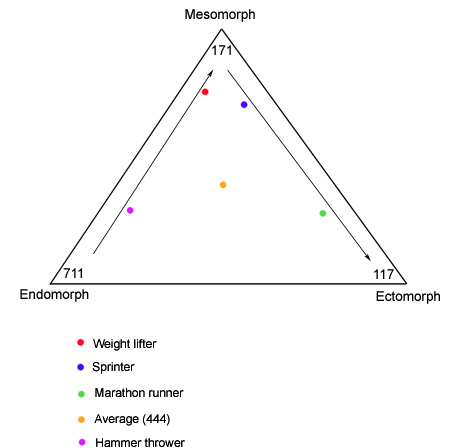
People with different body shapes, tend to be good at different sports. Most top level athletes will have a body shape which leans towards the mesomorph end of the scale as most sports require a good deal of strength. They will then have either ectomorph or endomorph features, depending on how lean they are and how weight affects their sport. For example, a weight lifter or wrestler will be more towards the endomorph scale, and a long jumper or soccer player would be more ectomorph.
The image above gives some examples of ideal somatotypes for different sports.Edited: 27 March 2013