Medical World
30 posts
- Please, leave any health issues under this section.
- When is the best time of exercise during one day and night ? and why ?please
- Dear master Jamshid, thank you for the question. I never thought about a moment in a day to be the best time to exercise before.
I think the best time could be the early morning, because the body is restored by the night's sleep. We are full of energy but we also should pay attention to avoid body accident. I think in the first part of the day it is very important to do a good warm-up and do some soft stretching exercise.
Due to work commitments we are generally accustomed to train in the evening, but I don't think this is a good time to exercise, because we tend to be tired after the day's activity. The muscles are easy to warm up but it could get difficoult to keep control of the movements.
So I could say that maybe the early day is good for energy but we have to pay attention because we tend to be more rigid and risk to damage the tendons, and the evening is worse for energy, better for the muscles elasticity and worse to keep control of the moves on a long lasting training.
I hope to have correctly understood your question. My answer is coming from personal experience and so it is just a personal point of view. Thank you. - Well, i think there is no best time. It depends on the individual. Everybody has different points of time during the day where it´s concentration and produktivity is max.
- Hi my dear friends , answering to this question depends to our objectives of exercise and hormonal and physiological changes in the human body !due to variation in Insulin and cortisol secretions during day and night ,human body is more performance in the evening almost between 18h and 23 h because cortisol is high and insulin down , mean while human nerves system is more adapted to hard exercises afternoon because of high activity of sypathetic system and low activity of parasypathetic system .So it is better to do very hard and long exercises for augmentation of perfomance at evening after 18 h .in the end of day we are more nerves and stress-ful so during exercises at evening we can release more tension and we will become more relax and then we will sleep better and at the next morning we feel better because of good quality of our sleep !
Please note if our target is diminution of weight or augmentation of our cardio pulmonary resistance it is better to do the exercises at early morning an empty stomach I mean between 5 h and 7 h .because our body is not completely ready to do extensive exercise and it will use more energy and more calory to do small efforts and we can augment our perfomance in small time and using little effort .because during early morning parasympathetic system is more active than sympathetic system and of cours insulin serection is high and cortisol secretion is down at early morning too ! so we will suffer more at morning and we are less ressisstant too .Some articles says it is better to limite morning exercise to maximum 45 minuts because of risk of damages on tissues . Morning eexercise must be limited to runing and jump rope or walking ! after several time of morning exercise if we feel trembling in our hands or legs it is better to stop this kind of exercises .
The wors time of exercise is between 01h and 05 h because human body is in his wors condition biochemically and physiologocally and concetration is very limited at this time and cortisol secretion is low and human body is exposed to damages very easily. We mustn't forget that choosing a time for exercise depends to our mood and psycological needs and having enough time ! so the best time of doing sports or exercise directly depends to us and our desires ,and it is better to do exercise when really we have enough time and we really want to do it .Don't say oh ! the best time of exercise is past so I'll do later ! no ! remember please that if we do some exercice when we have time ,it is better than nothing ! What we said is the theory concening to physiology of human body , but don't forget that every body is diffrent and special so we are the best person to find our best time of exercise more adapted to our body and mind. thanks to all of you - Cellular Respiration
What is Respiration?
Cellular Respiration is the process that takes place in cells to convert food into energy. This process is also known as internal respiration. In order to release the maximal amount of energy, the molecules of Carbon, Hydrogen, Oxygen and Nitrogen which make up our food are stored as a high energy molecule known as ATP or Adenosine Triphosphate.
The Products of Respiration
When energy is needed, ATP is broken down using an enzyme (known as ATPase) into ADP (Adenosine Diphosphate). This process breaks the high energy Phosphate (P) bond and so provides energy for use by the body. Here is the equation you may see in text books:
ATP = ADP + P +Energy
The human body is also capable of resynthesising ATP to allow it to continue producing energy. To do this it must use energy to reverse the equation shown above. This is known as an endothermic reaction as it requires energy. The breakdown of ATP is called exothermic as it produces energy. The process of breaking down and resynthesising ATP is efficient at producing energy as less energy is required to resynthesis the ATP than is made to break it down. Here is the Resynthesis equation:
Energy + ADP +P = ATP
What are the Energy Systems?indeed
There are two energy systems used in during the process of respiration. Aerobic Respiration, meaning 'with oxygen' which is used for long-term, steady paced exercise and day-to-day activities and Anaerobic Respiration or 'without oxygen' which produces fast bursts of energy for short, powerful bursts. The Anaerobic system can be divided into two further systems, ATP-PC and Lactic acid. All energy systems work together, but the intensity and type of activity will determine which system is predominant.
•Aerobic system
•Anaerobic system
1.ATP-PC system
2.Lactic Acid System
Aerobic Respiration:
The aerobic system produces the largest amounts of energy, although at the lowest intensity. At the start of exercise the body cannot deliver oxygen to the muscles fast enough to initiate the complex chemical reactions which occur during aerobic metabolism. Therefore the body relies on anaerobic processes for the first couple of minutes.
The aerobic system can be broken down into three sections:
•Glycolysis
•Kreb's Cycle
•Electron Transport Chain (ETC)
Aerobic Glycolysis
Glycolysis is the breakdown of Carbohydrates (in the form of Glucose or Glycogen) into Pyruvic acid and resulting in the production of two ATP molecules. A total of 10 chemical reactions are required to convert Carbohydrates into Pyruvic acid which take place in the muscle Sarcoplasm. Gylcosis can take place without the presence of Oxygen in the cells however on finishing Glycosis the cell decides which process to carry out. If Oxygen is present then the cell will perform Oxygen Respiration (aerobic respiration) and continue on to Kreb's Cycle.
Kreb's Cycle
Sometimes also known as the Citric acid cycle, or the Tricarboxylic acid cycle, this is the second phase in the process of aerobic metabolism. The Pyruvic acid produced during Glycolysis enters the mitochondria and is immediately converted to Acetyl Conzyme A which combines with Oxaloacetic acid to form a 6 carbon compound, known as Citric acid.
Further chemical reactions occur to wield enough energy to resynthesise 2 ATP molecules. Bi-products of these reactions include Carbon Dioxide (CO2), which is exhaled by the lungs and Hydrogen (H) which is transported to the site of the Electron Transport Chain by carrier molecules NAD+ and FAD. The process is termed a cycle due to the starting product of Oxaloacetic acid is also the end product, ready to start the process over again.
Electron Transport Chain
The hydrogen mentioned above is transported into the inner membranes of the Mitochondria where it is split into a proton (H+) and an electron (H-). The electrons are then subject to a series of redox reactions which release a large amount of energy in order to resynthesise ATP.
The protons also create energy by moving back through the inner membrane of the Mitochondria because of the redox reactions. This causes an imbalance of H+ and so they return through the membrane, producing energy. A final exothermic reaction is the combination of hydrogen with oxygen, to form water. The total ATP production during all of the reactions of the electron transport chain is 34, meaning it is by far the highest producing phase of aerobic metabolism.
Aerobic Respiration Equation:
Glucose + Oxygen = Carbon Dioxide + Water + Energy
C6H12O6 + 6O2 = 6CO2 + 6H2O + Energy
Anaerobic Respiration:
The anaerobic energy system provides energy in the absense of Oxygen. This is used in the first few minutes of all exercise, before there is suffiecient oxygen available at the muscles for aerobic metabolism. It is also used for fast, powerful bursts of energy, for which the aerobic system is insufficient. There are two systems within Anaerobic metabolism, which are the ATP-PC system and the lactic acid system.
ATP-PC System
ATP as already discussed is a high energy molecule which is broken down to form ADP and release energy. PC or Phosphocreatine is another high energy molecule, found in the Sarcoplasm of muscle fibres. The breakdown of ATP and so increase in volume of ADP triggers an enzyme known as Creatine Kinase to initiate the breakdown of PC into Phosphate and Creatine. Being an exothermic reaction, this provides the energy required to resynthesise ATP at a fast rate.
We only have 120g of Creatine within our bodies and so this repeated breaking down of PC in order to produce energy to resynthesise ATP is temporary and can only last a maximum of 10 seconds. Therefore the ATP-PC system is used mainly for bursts of speed.
Lactic Acid System
Sometimes also known as Anaerobic Glycolysis due to the initial process being the same as aerobic glycolysis (as mentioned above), only without oxygen. So, as before 10 chemical reactions occur within the Sarcoplasm which turn Carbohydrate into Pyruvic acid and 2 molecules of ATP. The difference now being the lack of oxygen meaning the carrier molecule NAD+ cannot offload the Hydrogen (H+) by-product of glycolysis causing a build up in the cell.
To try to prevent an increase in acidity the pyruvic acid accepts the H+, forming Lactic acid. If oxygen was present the H+ would be transported to the Mitochondria for use in the Kreb's cycle. Lactic acid is thought to interefere with muscle contraction due to disrupting the binding of Calcium to Troponin. Acidity also stimulates free nerve endings within the muscle, causing pain. Due to lactic acid production, this energy system can only be predominant for up to 2 minutes.
Following anaerobic exercise, despite the metabolic process used not requiring oxygen, your body will be in Oxygen Debt and so your respiration rate will be very high.
Anaerobic Respiration Equation:
Glucose = Ethanol + Carbon Dioxide + Energy
C6H12O6 = 2C2H5OH + 2CO2 + Energy - Human Body - Responses to Exercise
When you begin to exercise your body must immediately adjust to the change in activity level. Energy production must increase to meet demand with changes to the predominant energy system and fuel source occuring throughout the exercise in order to maintain the required level of performance.
Responses to Anaerobic Exercise
In order to immediately meet the sudden higher energy demand, stored ATP is the first energy source. This lasts for approximately 2 seconds.
When stored ATP is broken down into ADP + P, the rising ADP level stimulates Creatine Kinase to begin the breakdown of Phosphocreatine.
As discussed on the energy systems , the ATP-PC system can only last 8-10 seconds before PC stores are depleted.
The lactic acid system (Anaerobic glycolysis) must then take over as the predominant source of energy production. High intensity (but sub-maximal) exercise can last for between 3 and 5 minutes using this system
If the exercise continues at a high intensity, and so Oxygen is not available at a fast enough rate to allow aerobic metabolism to take over, the production of lactic acid will reach the point where it interferes with muscular function. This is called the Lactate threshold.
Muscles begin to fatigue when ATP resynthesis can no longer match demand.
Responses to Aerobic Exercise
Due to the necessity of Oxygen being present for aerobic metabolism, the first few minutes of low to moderate intensity exercise are powered by anaerobic metabolism.
Continued low to moderate intensity exercise is then fuelled by carbohydrate and fat stores using aerobic metabolism.
The intensity and duration of exercise determines which fuel source is used. Fat metabolism is a slow process and so can only be used as fuel for exercise at less than 60% VO2 max.
Carbohydrate is a much faster fuel source and so can be used for exercise up to 80% (in trained individuals).
Carbohydrate stores within the muscle and liver can fuel exercise for up to 80 minutes. As carbohydrate stores get lower, the body has to rely more and more on fat stores.
The intensity of exercise which can be maintained drops as fat cannot supply the required amount of energy. - Short-term Effects of Exercise
When we begin to exercise the body has to respond to the change in activity level in order to maintain a constant internal environment (homeostasis). Here are the changes which must take place within the muscles, respiratory and circulatory system:
Circulatory System :
The release of adrenaline (often before exercise even begins) causes the heart rate to rise
This increases Cardiac Output
Venous return increases due to the higher Cardiac Output and the skeletal muscle pump and respiratory pump
Increases in Lactic Acid (produced during the early anaerobic phase of exercise), Carbon Dioxide (due to increased rates of energy production) and temperature all act as stimuli to the cardiac control centre which responds by further increasing the heart rate
Oxygen levels within the blood decrease which causes increased diffusion at the lungs
Blood pressure increases, thus increasing flow rate and the speed of delivery of O2 and nutrients to the working muscles
Vasodilation and vasoconstriction ensure blood is directed to areas that need it (muscles, lungs, heart) and away from inactive organs
Respiratory System :
Changes in the concentration of CO2 and O2 in the blood are detected by the respiratory centre which increases the rate of breathing
The intercostal muscles, diaphragm and other muscle which aid the expansion of the thoracic cavity work harder to further increase the expansion during inhalation, to draw in more air.
Muscles :
The higher rate of muscle contraction depletes energy stores and so stimulates a higher rate of energy metabolim.
The bodys energy stores are slowly depleted
Myoglobin releases its stored Oxygen to use in aerobic respiration. O2 can now be diffused into the muscle from the capillaries more quickly due to the decreased O2 concentration in the muscle.
Long-term Effects of Exercise :
Regular exercise results in adaptations to the circulatory, respiratory and muscular systems in order to help them perform better under additional stress. Here are the changes which must take place within the muscles, respiratory system and circulatory system:
Circulatory System :
The cardiac muscle surrounding the heart hypertrophies, resulting in thicker, stronger walls and therefore increases in heart volumes. The more blood pumped around the body per minute, the faster Oxygen is delivered to the working muscles.
The number of red blood cells increases, improving the bodies ability to transport Oxygen to the muscles for aerobic energy production.
The density of the capillary beds in the muscles and surrounding the heart and lungs increases as more branches develop. This allows more efficient gaseous exchange of Oxygen and Carbon Dioxide.
The resting heart rate decreases in trained individuals due to the more efficient circulatory system.
The accumulation of lactic acid is much lower during high-levels activity, due to the circulatory system providing more Oxygen and removing waste products faster.
Arterial walls become more elastic which allows greater tolerance of changes in blood pressure.
Respiratory System and Exercise :
The respiratory muscles (Diaphragm/intercostals) increase in strength.
This results in larger respiratory volumes, which allows more Oxygen to be diffused into the blood flow (VO2 max)
An increase in the number and diameter of capillaries surrounding the alveoli leads to an increase in the efficiency of gaseous exchange.
Muscle :
Increased numbers of mitochondria (the cells powerhouse) means an increase in the rate of energy production.
The muscles, bones and ligaments become stronger to cope with the additional stresses and impact put through them.
The amount of myoglobin within skeletal muscle increases, which allows more Oxygen to be stored within the muscle, and transported to the mitochondria.
Muscles are capable of storing a larger amount of glycogen for energy.
Enzymes involved in energy production become more concentrated and efficient to aid the speed of metabolism. - Oxygen Debt & Recovery
What is it all about then ?
When you have a short intense burst of exercise such as sprinting you generate energy for this anaerobically or without oxygen. When you stop exercising you are still breathing heavily.
This is your body taking in extra oxygen to 'repay' the oxygen debt. Well, that is the simple solution but there is a little more to it if you want to look a bit deeper.
True, your body has worked anaerobically and will have produced energy without some of the oxygen it would normally have used performing low intensity exercise such as slow steady running. The difference between the oxygen the body required and what it actually managed to take in during the sudden sprint is called oxygen deficit.
When you stop sprinting and start to recover you will actually need more oxygen to recover than your body would have liked to use had enough been available. This is called Excess Post Exercise Oxygen Consumption.
So why does it take more oxygen to recover then?
You needed to replace the oxygen the body needed but couldnt get (oxygen deficit).
Breathing rate and heart rate are elevated (to remove CO2) and this needs more oxygen.
Body temperature and metabolic rate is increased and this needs more oxygen.
Adrenaline and Noradrenaline are increased which increases oxygen consumption.
So after exercise there are other factors causing an increase in oxygen needs as well as repaying the lack of oxygen during exercise.
The chart below is often seen and shows how the amount of oxygen used by the body changes over time. At the beginning the body works anaerobically leaving an oxygen deficit. Over time the oxygen consumption levels out to a steady state. After exercise the oxygen is pain back (oxygen debt). Notice the area of oxygen debt is greater than the area of oxygen deficit for the reasons stated above.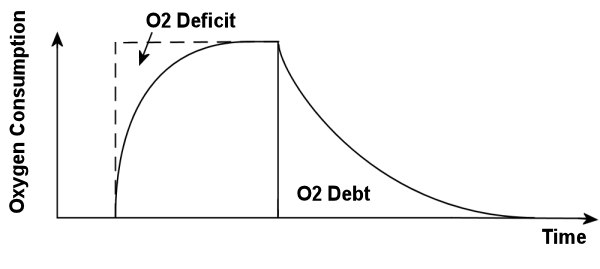
What has Lactic Acid got to do with it ?
Lactic acid is a by product of exercising without using oxygen (anaerobially). It is essential this is removed but it is not necessarily a waste product. It is recycled into other useful chemicals:
During prolonged intensive exercise (e.g. 800m race) the heart may get half its energy from lactic acid. It is converted back to pyruvic acid and used as energy by the heart and other muscles.
It is thought that 70% of lactic acid produced is oxidised, 20% is converted to glucose (energy) in the liver.
10% is converted to protein.
How long does it take to remove lactic acid ?
About 1 hour if cooling down with gentle exercise.
It can take 2 hours or more if you dont warm down with gentle exercise. - Sports Nutrition :
The subject of nutrition is complex and varied. It encompasses everything from weight loss and gain to sports performance and supplements. Here we aim to give you a basic understanding of the requirements of a balanced diet and the importance of this in sport.
A balanced diet for most people should consist of:
60% Carbohydrates
30% Fat
10% Protein
Vitamins, minerals and water
This does vary depending on the activity levels, type of exercise and health status of the individual.
Carbohydates :
These are found in starchy and sugary foods. Complex carbohydrates are mainly starchy foods, including potatoes, rice, bread and pasta and have additional nutritional value as they contain many other vitamins, minerals and fibre. Simple carbohydrates are the sugary ones, found in cakes, biscuits and sweets which are sometimes termed empty calories, as they provide no other nutritional benefits.
Carbohydrates are our main source of energy, in fact, energy from the breakdown of carbs is the only type of energy the brain can use. Carbohydrates are broken down in the liver and muscles, by a process known as glycogenesis. It is then stored as glycogen until it is needed.
Sports people, especially those involved in endurance events often require higher than the normal 60% carbohydrate intake in order to maintain large stores of glycogen and resist fatigue.
Fats :
Fats serve several important purposes. They provide energy and when stored, provide protection to our vital organs.
There are two types of fats, saturated and unsaturated. Saturated fats are 'the bad fats' which are normally solid at room temperature, such as butter and meat fat. Unsaturated fat is more difficult to breakdown and so is mainly stored within the body. Unsaturated fats are generally better for us and are often liquid at room temperature, for example olive oil and sunflower oil, although they can also be found in avacados and nuts.
A healthy diet should not contain more than 30% fat, and a maximum of 10% should be saturated fat. Fat provides a secondary source of energy and once the relatively small carbohydrate stores are exhausted, fat metabolism becomes the primary source of energy.
Proteins :
Proteins are large compounds consisting of amino acids. There are 20 amino acids which the body requires. 12 of these can be synthesised within the body, and the other 8 (essential amino acids) must be consumed through our diets.
Proteins are found in abundance in meats, eggs, fish, dairy products, nuts and seeds. Protein is essential for growth, repair and maintenance of our body tissues and for this reason, many athletes (mainly those requiring strength or size) will increase the amount of protein they consume, in order to help their muscles grow and develop strength.
Fluids :
Fluids are vital in any sport to help prevent dehydration. When we exercise our bodies sweat to help cool us down. This results in a loss of water which must be replaced so as to not inhibit performance. Electrolytes such as sodium are also lost in our sweat. For this reason many sports drinks contain a mix of water and electrolytes. The presence of these electrolytes also helps the water to diffuse through the small intestine, back into the body.
Vitamin and Minerals :
Vitamins and minerals are vital in the diet for a wide range of functions, but only needed in tiny amounts. Providing you have a balanced diet as shown above, containing lots of fresh foods, there is no need for vitamin or mineral supplementation.
Supplementation :
There are so many types of supplements now widely available, but for most people, providing their diet is balanced and varied, supplementation is not necessary. Some athletes may which to supplement their diets to enhance their performance, especially when the difference between winner and runner-up can be a fraction of a second, or a single millimetre. The most commonly taken supplements amongst athletes are protein, and creatine.
Protein based supplements are taken by those athletes wishing to increase their size and strength. Creatine is used by a wider band of athletes. It is promoted as a muscle performance enhancer as it is designed to allow reapeated powerful muscle contractions. Creatine is naturally present within the body, it is used in the ATP-PC system of anaerobic energy production, where PC stands for Phospho-Creatine. Having excess stores of creatine enable this anaerobic energy systems (and so a higher level of performance) to continue for longer. - International sport ?
The 19th century saw the start of international competitions. These have continued to grow and become more popular ever since. Just about every sport is played on an international level, from football, to show jumping to chess! Here are some of the big ones:
The Olympic Games - The biggest modern day international competition. There are both summer and winter Olympics every four years
The Pan-American Games - These are also held every four years (but so they fall in a different year!) and are competed by countries in North, South and Central America
The Commonwealth Games - The commonwealth is the group of countries which used to make up the British Empire. These competitions are also held every four years
World Cups - A lot of sports have world cups, like Football, Cricket and Rugby
Most sports now have their own world championships like athletics and gymnastics.
These huge international competitions obviously have positives, but they also have their negatives:
Positives :
The mix of cultures and ways of life which occurs when lots of people from different countries get together
When the best athletes in the world compete against each other the standard improves - which is why you often see new records being set
International events encourage lots of people to get involved in sport
Negatives :
These big events are very costly which means many poorer countries cannot afford to host them
Even bigger countries need help from big businesses in the form of sponsorship which makes events like this very commercialised
Some countries want to be successful at sport to prove they're better than a rival country !
Attitudes :
Every country wants their sports people to succeed because it brings the country pride and status amongst the top sporting countries. It can also help bring a nation together and encourage people to start exercising and become healthier. However, different countries promote sport in different ways:
UK : Phisical Education is compulsory in schools and they have introduced sport for all campaigns to get more people involved after they leave school. For their top competitors there are grants and sponsorships available.
USA : Again Phisical Education is compulsory in schools and school and college sport has a very high profile which attracts sponsorship. There are a lot of scholarship schemes to help athletes get into college, from where they can be drafted into professional leagues.
Former Eastern Bloc (countries once dominated by the USSR) : Sport was controlled by the state and talented children started training for sport at a very young age. They were also given token jobs in the army or industry so they could spend more time training. Since the collapse of the USSR in 1989, sport has been more open.
Third World Countries : Sports which cost the least money are promoted, like football and athletics. If athletes succeed on an international stage this brings more money into the country. Athletes are often supported by giving them token jobs within the government - Age and Gender in Sport :
The fact that women rarely compete against men, children are not often involved in adult competitions and there are sometimes separate veteran events show that both a competitors age and their gender affects their sporting performance.
Effects of age in sport :
A competitors age will affect their performance in the following ways:
Strength :
Children are not as strong as adults. We do not reach our maximum strength until we are fully grown at around 20
In your 20's and 30's it is easy to build up strength and muscle mass
In your 40's and onwards strength decreases as protein levels and muscle mass falls
Flexibility :
We are most flexible as adolescents
As we get older we tend to loose this suppleness
Oxygen capacity :
Our capacity to transport and use oxygen so effectively falls as we age
Injury and disease :
As we age, weakness and inflexibility make us more prone to injury
It also takes us longer to heal
Diseases such as cancer and heart disease are more prominent in the older population
Reaction times :
As we age, we get slower to react to a stimulus
Experience :
Older athletes are often called experienced, and this experience can be an important tool
Experience helps us to know how best to deal with a situation
In some sports age isn't a disadvantage. Sports which do not require strength, flexibility or endurance capacity can be competed in by both young and old. Sports which require accuracy or concentration, such as bowls and darts.
Effect of gender in sport :
Men and women rarely compete against each other because of some significant differences in our physical make-up:
Men have longer, heavier bones
Women have a wider and flatter pelvis
Women carry more body fat than men
A womens menstrual cycle can affect her performance
Men have higher testosterone levels and so bigger, stronger muscles
Women tend to be more flexible due to a lower muscle mass
Girls reach their physical maturity at 16 or 17, 3-4 years earlier than boys - Dear friends, I find this topic really interesting!
Being a woman I recognize all the "gender effect" on sport, although this had never been a problem to compete with my old male hamrahs. But I don't get the link with the "wider and flatter pelvis". Why should this affect somehow the performance? Can somebody explain me this, please? I don't get it. - Hi dear friend,
Women have different shapes and forms of pelvic , so , the angle of acetabulum and head of femur change because of these differences . We see different shapes and body forms ( anatomical difference) between women too ! specially different hips and forms of legs (tight and knee ,...) again due to these variations in the angle of acetabulum and head of femur . These anatomical differences plus phisiological differences cause different perfomance and different strenght between ladies and between ladies and men . - Dear James
I searched the web for a picture ( I need to see to really understand ) and I guess this angle can affect also the flexibility.
Thank you so much for the answer! - Dear Patrizia as I said before women are more flexible than men becaus of difference in anatomy and phisiology . If you did before the sport and then you stoped it for a long time, your body has changed and you lost big percentage of your flexibility . but please don't bother yourself ! the best and more streghnt kick is a straight one and doing high kick is not very important in real combat and it is not powerful and it needs more energy too . Finaly I would like to say for donig kung fu toa you don't need open your legs 180 degree and if some people do it ,it doesn' mean that they are more powerful than otheres .
only you need some dergree of flexibility to avoid injuries - Dear Jam. thank you!
Indeed I lost flexibility and I have to pay attention because as soon as I stretch too much, the day after I feel my hips blocked, sometimes I feel like a little "electric shock" to a tendon and I have to kick lower!This means I really have forced to much and so I get the opposite effect.
You have already told me once that it is not so important to kick high and I understand that you are perfectly right!
I will "carve and print" this concept in mind. Thank you for all your precious advice!Edited: 24 October 2012
- Hi dear friend , in this level and after several years of training it is not normal to have pain or electric dischrage in muscles the day after exercices ! I think your arrengement and your managements of training are not adapted to your anatomy and even not to kung fu toa . normaly the day after training you must feel better and full of energy and happiness ! may be you use your old manier of training , what I saw in some of their video ,it was completely incorrect .
- Dear Jamshid, not in the muscles, at tendon's level (left hip to be precise). I've had this problem since a physiotherapist found that I was "stuck with a femur" and made a move with my left leg, but it really hurted!From that day on I have lost flexibility and I feel something like a tendon move when I stretch too much as if it was out of place, and usually when it goes back it gives me goose bumps!!
Anyway I fear you are right, the day after I usually feel tired but I think is normal because I have a very active life (a tough job, always walking and lifting weight) and I really sleep not enough. But I know I have to change something in my training too, indeed I am using half of the old system and I neglected the other half because I felt it was not working with me.
About the video, I know what you mean and you are right. I was trying to "understand" some techniques but of course in the wrong way. I 'm really happy to have sent them to you or I would have never realized how much I was wrong! I'm following your precious advice and it is getting better (with a lot of patience of course...it takes time)
I am "searching for the mistakes", but I fear there must be a lot. One by one I will find them. Thank you. - Where exactly this pain is? its on muscles level or joint, I had similar experience.
I have not seen your warm up exercises cannot comment I am sure you need to adjust some of them,
Generally warm-up exercises are from what I have seen is not right.
If you feel tired next day you might need to adjust your body fuel intake (food / drink).
Electric discharges in some level are possible!Edited: 24 October 2012