Question
548 posts
- TO'A!!
From the bottom of my heart thank you!! - Dear Ostad Jalilzadeh, I have one question about atado.
In the lessons, we have done keyeto right, mato left and we go on weiyma doma left and afma right.
Page "atado3-8.jpg", you say we go for doma mato left in cat position, and then we go on horeima rato.
Now, I need to have the concept clear in my mind.
By the way you move, I would say you are doing a doma defend. This makes me go back on the classic techniques, and I ask myself about doma defend and doma mato.
I thought doma mato is different because we make power from the side of the body, and we take the arm a little bit in horizontal.
I thought that doma defend is "defend" because before blocking in front of us, the arm that is doing doma is vertical, 90 degree to the ground defending from a mato or another technique coming in front of us.
But if you call in atado the technique "doma mato", this makes me thing that it is not being 90 degree or not to make a doma mato...a doma mato! and that a doma defend is a defence because we block in front of the body, meaning that it is "doma mato + blocking".
I don't know if I have misunderstood the classic technique or atado!
I hope to have been able to make me understood and to have explaied where I found the problem, and I hope not to sound too much confusing.
In short:
-atado: is that really a doma mato?
-classic technique: doma defend is than doma mato combined with blocking? (If I don't go for the block than it become a doma mato?)
Thank you so much!! - Dear Patrizia, it is a Duma defense . I have to look the video tonight and tell you what it's going on. I may have mistake by saying Duma Mato instead of Duma defense.
- Dear Ostad Jalilzadeh thank you!! now it is clear.
If you say like this, than it is simply a word for another, a "lapsus"!
Duma defend, not duma mato! Wow, I feared to have misunderstood everything and I was trying to find where I was wrong, and to get it I did some whirls of reasoning!!
Problem solved easily then. Thank you so much! - It's fixed .
As I said it was misprint.
Thank you to let me know. - Dear Ostad Jalilzadeh, of course. With Lapsus I meant exactly this, a misprint. You are perfect and precise as always!
Thank you so much!!! TO'A - Dear Ostad Jalilzadeh,
I wish to ask you something about atado. For the moment not about techiques, your lessons are perfectly explained so in this very moment everything seems clear.
-We end saying "Suto Kung fu ka". I knew that all the mummayies end with the name of the next step. Why do we have to add "kung fu ka" and not just say "Suto"? Is it something related to a philosophical meaning, or this is the name, and this is it?
-Another thing is this: I knew that all the mummayies end in the same way, with the hand fisted in front of the forehead (I knew it as in Kamisemay, anyway...). But Atado end with open hands and than you bow to the Yaromeh. This means that every step has a different way to be closed? I thought that taking the fist in front of the forehead was a must.
-Last thing is about the fists in Kamisemay. This is something that was so much recordered in deep in my mind that I didn't noticed. I knew that one fist is apart from the other of the misure of a fist. I mean, the distance between the two hands is the exact leght of the width of the fist. But I noticed that in the pictures and in the video too you are not so closed, your hands are more separated. So, the roule of the "width of the fist" does exist or not?
Thank you. - Dear Patrizia, you are asking good questions, which makes me believe you are a true Kung fu ka.
-At the end of Atado we announce "Suto Kung Fu Ka" because it is the stage's name. We usually call it "Suto". But suto is not the whole name. The name of the stage is "Suto Kung Fu Ka".
-You are wrong, all mummaies do not end with the fist in front of the head.
-For the last question I am going to attach a picture that you people have never seen. In that picture you can see the Kamisema position with open hands as wide as your shoulders, which we used to take Kamisema like that on early years.
When Yaromeh started to make To'a away and separated from Chinese and Japanese styles. He changed lots of things. One of the those changes was Kamisema.
At the Kamisema position the fists separate from each other minimum as a fist long, maximum with shoulder size.
So if you keep your arms at Kamisema position away from each other minimum fist long and maximum shoulder long would be OK.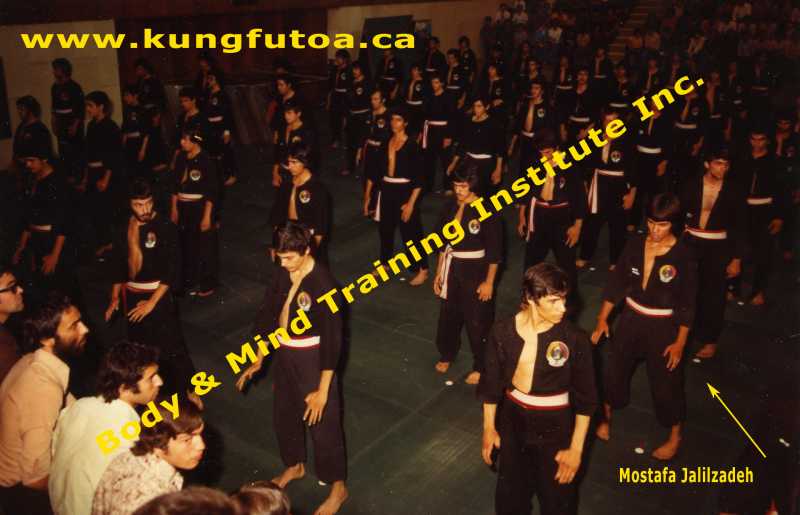
Edited: 26 December 2012
- Thank you so much dear Ostad Jalilzadeh. Your answer as always is simply perfect! To'a!!
- Dear Ostad Jalilzadeh, thank you so much for the videos! They are great, and to us european people hearing your voice is fantastic, this allow us to say correctly the names of the kia and mummayies, which is so important too, as all the other things.
I was asking myself about the end of Atado, when we go in Kamisema position. When we go there, as you taught us, we are not doing any technique but we are doing a sign. But then you said: "put a right Duma Mato on the left side of your chest with the left hand on the side position". So, if it is not a technique, is there a reason for calling it "Duma Mato"? Why not simply "put the fist to the chest"? I linked it to the heart level, left side, which makes me recall another thing, the fact that when we put the sash on we hold it with the left hand, the heart side. I fancy that it might be a sign of allegiance and loyalty . Am I right? But then again....why "duma mato"?
I was thinking also about Chino. The classic Chino is to defence the front of the body and for dividing the power of the body. In Atado you explained clearly that is very very important to make it with fist 45 degrees inward and at shoulder's width and at sash's hight. I think Chinos so little separated should not be so effective as a defence. Are they then just for dividing the power and for balance? Excuse me if I question it again, I think that probably I already asked you somewhere, but the idea of Chino as a defence is like a drill in my mind, I need to know if it is right or wrong.
Thank you. - Dear Patrizia, you are right on both subjects.
Putting a fist on the chest (heart) is symbol of love and loyalty.
The Duma Mato way is to make it the same and unique for everybody. Otherwise everyone is going to do it a different way, which isn't right.
You're right about Chino for divided power. It is one of the reasons.
You know the balance is the major skill learned in Atado and making a Chino like that is mostly for making balance.
When you make the body have smaller portions (smaller Chino and short Matos with the legs up) it is easier to have balance and fight with gravity.
Keep up the good work. - Thank you so much dear Ostad!
Your words made me realize that in Anattawa matos are longer, I hadn't tought about it before. I am thinking about Yeteh Mato, and Mato-up in Waisa axis (mato up-mato down 2 times). This makes me think of a defensive mummay in which we learn to hold a relative distance. In Atado we have a shorter distance, and we learn to defend ourself in a smaller space. Am I right? On Atado we go closer, we grab & throw away, or hit the nose, or the shoulders or the groin. This require a closer distance. Correct? - That is right, you have got it.
- Thank you so much dear Ostad Jalilzadeh!
- Dear Ostad Jalilzadeh, as you know I keep on thinking about the things already learned and sometimes I find something that is not clear. I was thinking about Anattawa.
I realized that if I look at each technique in all the mummay, everything is a defence or an attack. But at the beginning, when we turn and do the kia "Heiss", we take the fists to the side of the body in yeteh rato, this is not a technique, instead it is only for breathing, right? the only reason is to take out all the air from the lungs. So we could say that those 3 movements are the only 3 that are not really techniques, am I right?
The reason because I am asking too bad is always the same...sometimes I have an old and fake memory that comes out and I don't want to mess up!
Another thing is about gados. Is there a way to understand and distinguish them? You said that "gado" means "guard".
In Anattawa you said that before going to "Haima" when we take the foot in cat position and the right arm in front of the body horizontal to the ground and the left straight, that is a gado. So we have 4 of them from this side, everytime before going to haima technique. When we turn and go to wais-kineh, you talk again about "guard" before going to oranto from out and afma technique. So those should be other 2 gados, correct? What makes me think is that in that position the action hand that will end in oranto is at 90 degree to the ground, the position is very open. Is it really a guard, or I have misundertood? If it is a guard, and the opponent is in front of me, I thought I should have a more closed position.
If I search for something alike, I would think that a guard of the same type should be the one when we are in waisa axis and again we go with oranto from out to 45 degrees, before Mato up-Mato down sequence. Before doing the technique I take my body in a position that is similar to the one before going on Oranto from out. Ant this makes me think that this also could be a Gado. If it is like this, those could be other 2 possible gados. Correct or wrong?
So, how many gados are in Anattawa? are they the 8 position I found or not?
What about Atado? are there any Gados? and if so, where are they?
Thank you so much! - Hello my friend and with permission of Master Jalilzadeh , I think that mumays has 3 profits : 1- with doing mumay we workout in different angles and axes and positions , so, our body and mind will used to all posible positions and angles
2- with repeating mumay correctly internal energy develope and flow in all of body correctly
3- with doing mumay our body and mind memorise the technic and with repeating of mumay technics become our instant and part of our attitude and technics become part of us .
Each form has its special technics and positions but at the same time each form is a preparation for next form too ! if we don't learn anttawa correctly then later we can not realy learn atado ! and if we don't learn atado correctly then learning suto is very difficult ! and so on .
So I think in Anattawa not only we learn some technics ( defence or attack and even self defence ) but also we learn some different positions and how to turn our body and how to do Kiays and correct respiration and also doing different reactions that all of these are necessery later in other forms !
Concerning to Gado I think it is a guard just befor an action, I mean we prepare an action and we have to change our classic guard or position for being functional . Indeed gado is functional guard before defence or attack .Edited: 28 December 2012
- Thanks Dr. Javidan, you are right about Gado.
Dear Patrizia, in Anattawa we take both our arms back like 'Heis" four times, one in the beginning from Sensesero position and three on Duma defense techniques. But we say Heis three times.
All of these movement count as techniques. When we say technique, it doesn't mean we have to do some thing to attack or defend. Some times we do a move to make the body ready for an attack or defense. Here is like that too, when you move and say 'Heis", take all the air out of your body and stay like that, it means you make yourself ready to get punch or kick. So it should be a tactic some times for showing you are ready to take a hit to bring the opponent morality down and show your power and ability.
you are right we have 8 Gadoes in Anattawa.
As I explained before Gado is Guard. So when you have a guard, it is either for an attack, a defense, to make power or simply to show to make your morality up and the opponent down.
Here in Anattawa all of them are to make power and give the techniques a round power from the side to the front because we are at the position that the reaction is not fully functioning before the technique.
Yes we have Gadoes in all the stages including Atado.
In Atado, when we go to hit double Mato, one to the face one to the body. Before that move we have to make a Gado.
Look at the picture below, number 5 is a GADO.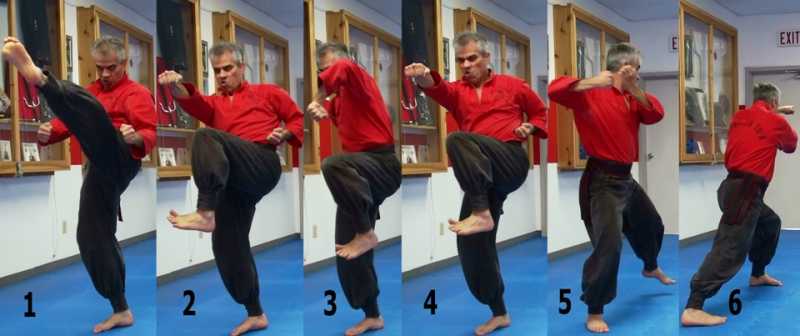
Edited: 29 December 2012
- Dear Ostad Jalilzadeh and dear Jamshid, thank you so much for the answers!
To Jamshid: I have never thought of a mummay as a preparation for the next one, thank you! About the gados, at the moment I didn't got what you meant, but after Ostad Jalilzadeh's answer I got it.
Functional guard before an action. I think the key to understand it is the term "funcional".
To Ostad Jalilzadeh: Thank you!!! Yes we take 4 times our body in position with hands on the side and 3 times we say "Heis", I noticed before but I didn't got the reason. Now I got it!Here is like that too, when you move and say 'Heis", take all the air out of your body and stay like that, it means you make yourself ready to get punch or kick. So it should be a tactic some times for showing you are ready to take a hit to bring the opponent morality down and show your power and ability.
Finally I got the sense of that technique! completely different from what I knew (that was without any sense).Thanks again! Usually everytime we go in that position we take the air out and say "heis", we do like this also in atado. the only exception is the 3rd time in Anattawa. I ask myself why....maybe it would be too much? I mean, maybe saying it every time at so short distance I would take my energy down and have the opposite effect?As I explained before Gado is Guard. So when you have a guard, it is either for an attack, a defense, to make power or simply to show to make your morality up and the opponent down.
Here in Anattawa all of them are to make power and give the techniques a round power from the side to the front because we are at the position that the reaction is not fully functioning before the technique.
Thank you Ostad, this is the perfect explanation I needed!! This allows me to search for them in all the mummayies.
About Atado: right!! I had missed. I mean, I knew it without being fully aware anyway. I searched first in my memory and than in the pictures, and I found only 2 gados in Atado, which are both those you mentioned. Did I got correctly?
So 8 in Anattawa, 2 in Atado?
Thank you again! - Dear Ostad Jalilzadeh and dear friends, I know it is hard to explain in written words, but I wish to understand a technique in Atado.
Before doing Yeteh keyeto and exhale the kia "jummay", we grab the collar of the opponent's shirt, pull in, hit huto "and throw the person by hitting with the right shoulder making you ready for the Yeteh Keyeto" .
If I hit the person with Huto and throw him by pushing him with the shoulder (??), this means that there should be a contact shoulder-chest I suppouse. Sorry for the question, I never tried a technque like this. than the person should go on the floor right? and does this means that yeteh keyeto hits another opponent? Have I got it?
Excuse me if my questions are so "basic". - No, you have not...
As a good fighter you have to realise, what would happen after your act? Is the opponent going to go down? Is he/she going to get hurt? Or is nothing going to happen. Is he/she able to defend or re attack? Or what is your tactic for that movement? And more ...
My opinion for fighting is to have a backup for any move, which is the same at this technique. The Yeteh Keyeto is the backup in this case. It means, if the Huto or shoulder techniques do not work, your backup is the Yeteh Keyeto.
Don't forget you are doing a form that is making your body practice to have balance and fight at two different directions.
When we do a form, it means we are practising techniques after another. Backups are most of them plus directions.