Training for children
9 posts
- Dear Ostad Jalilzadeh,
please would you suggest me an ideal training for children aged 8-10 and which techniques they'd better learn at this age?
Thank you! - My dear lady Valentia,
You know better than me, we can not put too much pressure on kids.
I think you should make a fun environment first. Then try to teach them with playing games.
Good thing we have Pre Anattawa which has made easy to learn the basics. - Hey - it just says master m . jalilzadeh., But it should be noted, is the best exercise for young gymnasts. Children are advised to turn first of all to the sport like gymnastics disciplines mother called. After age 15 than children in other sports body styling register.
- Dear Hamid, she is a teacher herself.
She is asking how to teach Kung Fu To'a to the kids on that age, the easy way. - Hi my friends ! I would like to say that children can start kung fu TO'A training from 7 years old and even they can do many of exercises & techniques ! There are different progammes for children and it depends what we are looking for . But kung fu to'a teachers or martial art teachers must pay attention to some special rules ! For example the programme must not make the weight loss in children and even in juniors! Runing and Cardio training must be limited ! for example 5 min runing is enough and for warm up it is better to prepare the games and play the games and has some mouvements to warm up all body and specialy leges . in one général rule everything we do for adult men we must do half of them for ladies and 1/4 of them for children ! too much jumping is not good for children and all kinds of fighting before 12 years must be forbiden .All kinds of benken and body conditioning are forbiden before 16 years old. teaching of all techniques and all mumays are permited . For children of 8 to 10 years old it is better to learn all basic rules and stances and some self defence techniques and fter warm up the best training is doing dynamic and static stretches and developpe flexibility of children but please pay attention to normal anatomic range of flexibility of each joint ! for example for openin legs horizotal and vertical we must not pass 180° in the final result and effort ! never go by physical or mental aggressivity ! learning kyeto , yete kyeto , osya kyeto and yad kyeto and all kind of low kicks and even osaya yad kyeto and simay kyeto and hurayma kyeto and all kinds of mato and kinds defence techniques are permited . teaching static ZEN and the correct way of breathing and how to be relax when we are tired or under stress can be very good thing ! Generaly between 7 years old and 12 years old training is limited to one hour and it must divided to half an hour of warm up and gym and stretches and then half an hour of techinques and in the end again 5 or 10 min stretching and correct breathing . Pay attention please to 3 points : 1-never try the extreem tachycardy with children 2-A children must not loose the weight 3-the training must not put the presure or damage to to Epyphyseal plates ( plates of growth in the bons) for example fighting or jumping too much or body conditioning are forbiden.
good luck and TO'AEdited: 31 May 2013
- Thank you dear Ostad,
Iin effect I think last year I put too much pressure on them (I tought them all the loose techniques you explained in the website), thought at the end we always had games to relax their brains, so I don't know what they will remember in the future . At the beginning we had a training much similar to gymnastics, then loose techniques and eventually fight. I will try next schoolyear as you say with pre-anattawa.
Thank you again and my kind regards,
To'a! - Thank you dear Jamshid,
I will consider all of this. They only do a little fighting but with very very soft contact. Do you think it's allright? In between training and techniques we sit down in zennay for breathing.
I will insert more stretching and breathing in the end.
Thank you for useful inputs
To'a - Thank you dear Hamid,
I referred to Master Jalilzadeh but of course I will consider good advice from any of dear Masters and Hamrahan of Kung Fu To'a family. - Growth plate injuries :
this article concerns to sports damages section but I think it can be more useful in this topic so I beg your pardon
When you think of growing bones, you might think they grow out from the center of the bone. But the long bones in the legs and arms grow from an area at either end of these bones called the growth plate, epiphyseal plate, or physis. These areas produce new bone tissue and determine the final length and shape of bones in adulthood.
If not treated, an injured growth plate might not do its job properly, which can lead to crooked or misshapen bones, limbs that are too short, and even arthritis or long-term skeletal problems. But these occurrences are rare. With treatment, the vast majority of kids recover from growth plate injuries.
About Growth Plates :
All long bones have an area called the epiphysis, which is the rounded end of the bone. The long, middle part (or shaft) of the bone is the diaphysis; the area where the bone gets wider at its end is the metaphysis.
In a growing child, growth plates sit between the metaphysis and the epiphysis. Also called epiphyseal plates, these growth plates are the developing tissue at the end of long bones that grows in length. Growth plates are made up of cartilage, a rubbery, flexible material in the body (the nose, for instance, is made of cartilage).
When a child's bones have completed growing (or reached skeletal maturity), the growth plates ossify (harden) and cause the epiphysis to fuse together with the metaphysis, forming one complete bone. (The hardened, mature growth plate area is then called the epiphyseal line.)
Girls tend to reach skeletal maturity earlier than boys; their growth plates usually close around ages 14 to 15, while boys' growth plates close later, at around ages 16 to 17. However, before growth is complete, the growth plates are susceptible to breaks or fractures. An adult whose bones have finished growing might simply pull a muscle or a tendon after a fall. But in a child, that same fall could not only injure the muscle and tendon, but also the growth plate.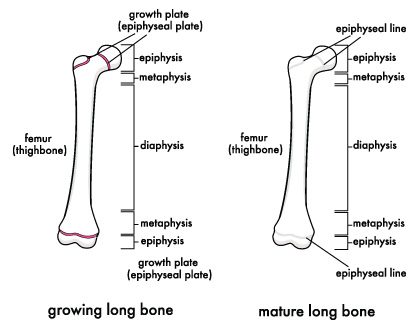
Causes of Growth Plate Injuries :
Most of the time, growth plate injuries happen from contact sports like football or basketball or from activities that require repetitive training, like gymnastics, track and field, or pitching a baseball. Other injuries happen during fast-moving activities with a high risk of falling, including skiing, skateboarding, sledding, and biking.
Growth plate injuries also can be caused by:
a car accident, a sudden fall, or exposure to extreme cold
medical conditions that affect bone growth
medications that have an affect on bone growth, like treatments for arthritis or cancer
Signs and Symptoms :
Because kids heal very quickly, a fractured growth plate not treated by a doctor can heal improperly, causing the bone involved to end up shorter or abnormally shaped. So, it's extremely important to get medical attention within a few days (preferably hours) if you suspect your child has an injury.
Signs and symptoms of a growth plate injury include:
inability to put weight or pressure on the limb
pain or discomfort
inability to move the limb
First Aid :
If you suspect your child has a bone injury, try to give first aid until medical care can be provided:
Remove clothing from the injured area.
Apply an ice pack wrapped in cloth.
Keep the injured limb in the position you find it.
Place a simple splint, if you have one, on the broken area. The splint should be applied in the position of the injured limb to help keep it from bending or moving — do not try to move or straighten the limb. Splints can be made by using cardboard, a stack of newspapers, or anything firm, and can be padded with pillows, shirts, towels, or anything soft. Splints must be long enough to extend beyond the joints above and below the injury.
Get medical care, and don't allow the child to eat in case surgery is required.
A child with an open break (bone protrudes through the skin) and severe bleeding needs to have pressure applied to the bleeding area with a gauze pad or a clean piece of clothing or other material. Do not wash the wound or try to push back any part of the bone that may be sticking out.
After the child receives medical attention, make sure to elevate the area and apply ice packs or cold compresses for 20 minute intervals every few hours for the first 2 days after injury. This will help reduce pain and swelling. Over-the-counter pain or anti-inflammatory medicines may be given to alleviate discomfort.
Diagnosis :
In the emergency room or doctor's office, doctors will ask how the injury occurred and may perform some physical tests, like applying pressure to the bone or joint to see if it's unstable.
Because growth plates are soft tissue, they rarely show up on X-ray images (instead, they appear as a gap near the end of the bone). X-rays mainly show just the hard, calcium-containing parts of bones. But doctors can still tell a lot from an X-ray; they often take X-rays of the injured limb and also the opposite limb for comparison.
Sometimes an MRI or CAT scan of the bone is also taken. These tests can detect problems in soft tissues better and help doctors confirm the diagnosis and type of growth plate injury:
Type 1 injuries involve a fracture in the growth plate that does not cause the bone on either side to move out of place.
Type 2 injuries break through the growth plate and the metaphysis.
Type 3 injuries break through the growth plate and the epiphysis, the tail end of the bone.
Type 4 injuries fracture through the growth plate, the metaphysis, and the epiphysis.
Type 5 injuries are crush or compression injuries to the growth plate.
Treatment:
Treatment for growth plate injuries initially involves resting and not bearing weight on the affected limb. Most of the time this can be accomplished by wearing a cast, splint, or brace over the area to prevent movement. This may be the only treatment necessary for minor growth plate injuries.
Other times, however, bones that are displaced may have to be manipulated back into place through a gentle procedure, called a reduction. A reduction can be done quickly in a doctor's office and only takes a few seconds to put the bones back into alignment. Afterward, the child may wear a splint or a brace for a few weeks to ensure that the bones do not move out of place.
In kids older than 13 or young children with complicated injuries, surgery might be needed to realign the bones and fix the growth plate. Surgical plates, screws, or wires might secure the area so that the bone continues to grow normally. After surgery, some kids will wear a cast during recovery.
After the fracture has healed, some kids might need physical therapy to help strengthen the area around the injury, restore normal movement if a joint (like the elbow) was affected, and make sure bones and joints are functioning normally.
Outlook :
Most kids who are treated for growth plate injuries do not have any long-term complications. However, frequent follow-up at the doctor's office (for up to a year or longer) is important to make sure bones are healing and continuing to grow normally.Edited: 31 May 2013